NTS Analytica is a spinout from the Analytical Chemistry Group at the University of Copenhagen and has access to its chromatographic and mass spectrometric infrastructure through established collaboration agreements. This gives us access to a broad range of GC, LC, SFC, GC×GC and LC×LC platforms coupled with high-resolution mass spectrometry.
Before compounds can be identified by mass spectrometry, they must be separated. Complex matrices require modern chromatographic methods.

UHPLC systems optimized for rapid, high-resolution separation of polar and semi-polar chemical species.

Modern GC systems utilizing capillary columns for volatile and semi-volatile contaminant analysis.

SFC providing orthogonal separation power for chiral mixtures and very polar compounds.
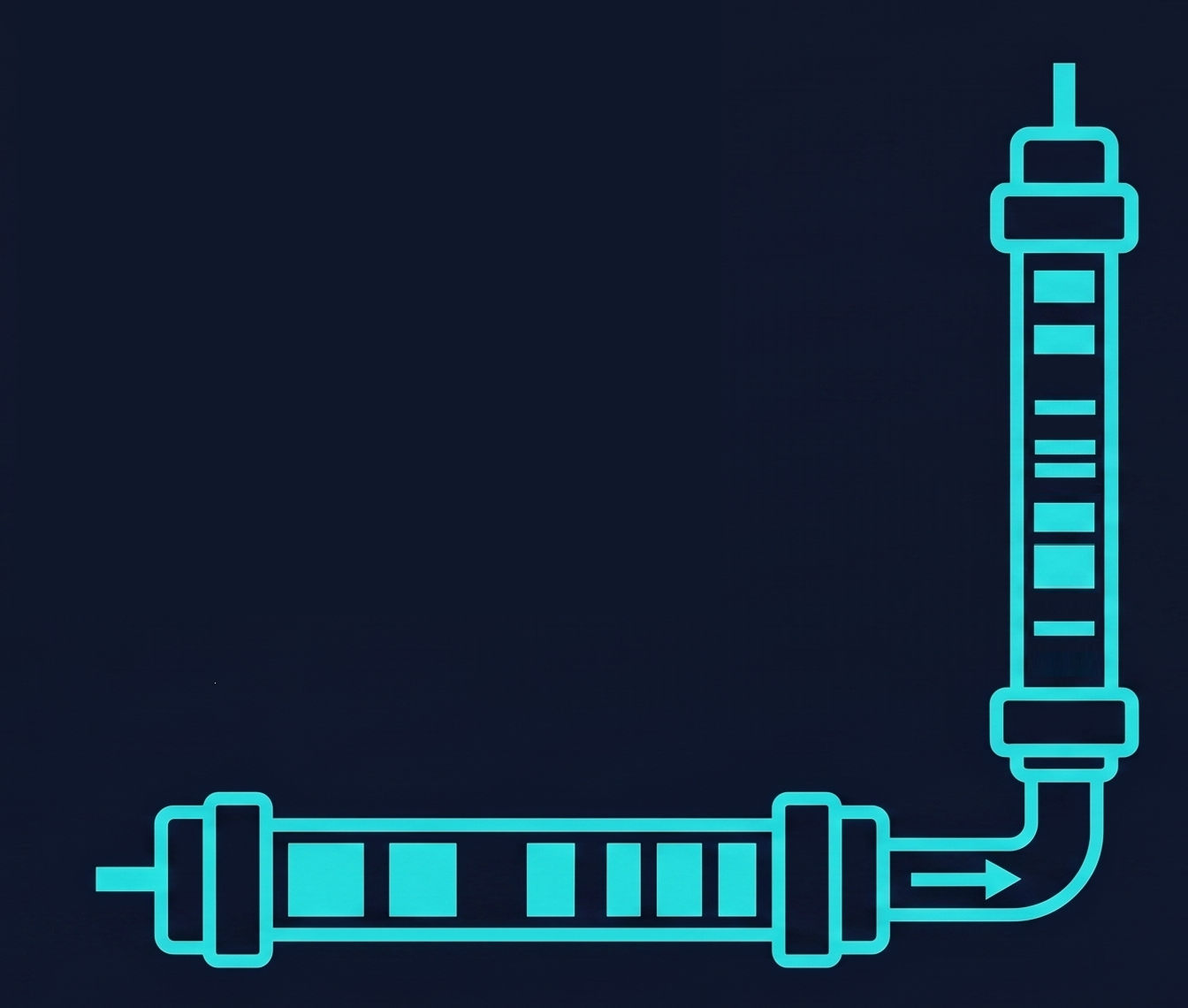
LC×LC and GC×GC coupling two orthogonal separation phases to resolve co-eluting peaks in highly complex biological and environmental matrices.
The core of NTS Analytica's NTS engine lies in accurate mass analysis. We toggle between technologies based on analytical needs.
Q-TOF platforms offer rapid spectral acquisition rates (up to 50 Hz) and high dynamic range, making them the gold standard for high-throughput screening and differential sample comparison. By resolving isotopic patterns with high mass accuracy (< 3 ppm), they facilitate fast verification of molecular formulas against large suspect lists.
When dealing with complex isobaric matrices (different compounds sharing the same nominal mass) or requiring absolute confirmation of a chemical structure, we deploy Orbitrap systems. Delivering ultra-high resolutions (up to 240,000 FWHM – Full Width at Half Maximum, or higher), these systems separate overlapping features and resolve fine isotopic signatures (such as nitrogen/carbon isotopes), removing all ambiguity in formula assignments.
For research partners and advanced stakeholders: a detailed mapping of how we process mass spectral data into confidence-based chemical identifications.
We utilize optimized extraction protocols designed to preserve maximum chemical diversity. Samples are analyzed via LC, SFC or GC coupled to high-resolution mass spectrometers to generate high-precision mass data.
Raw files are processed using optimized algorithms for peak alignment, deconvolution, and chemical noise filtering. We compile thousands of signals into a clean list of unique molecular features characterized by exact mass, isotope ratios, and retention time.
We perform rapid screening against extensive local and public spectral databases for suspect compounds. For true unknowns, structural elucidation is conducted via in-silico fragmentation, isotopic fine structure analysis, and retention time modeling.
We value scientific integrity. Every identified or proposed compound is annotated according to the Schymanski Scale of Confidence (Levels 1 to 5), ensuring you know the precise level of validation behind every result.